The 9-Stage Booking Funnel for B2B Agencies on Meta Ads
The full 9-stage self-optimizing funnel BuyRadar runs for B2B agencies on Meta. From the ad that filters before it gets a click, to the weekly creative loop that learns from every sales call. Step-by-step breakdown with the mechanic behind each stage.

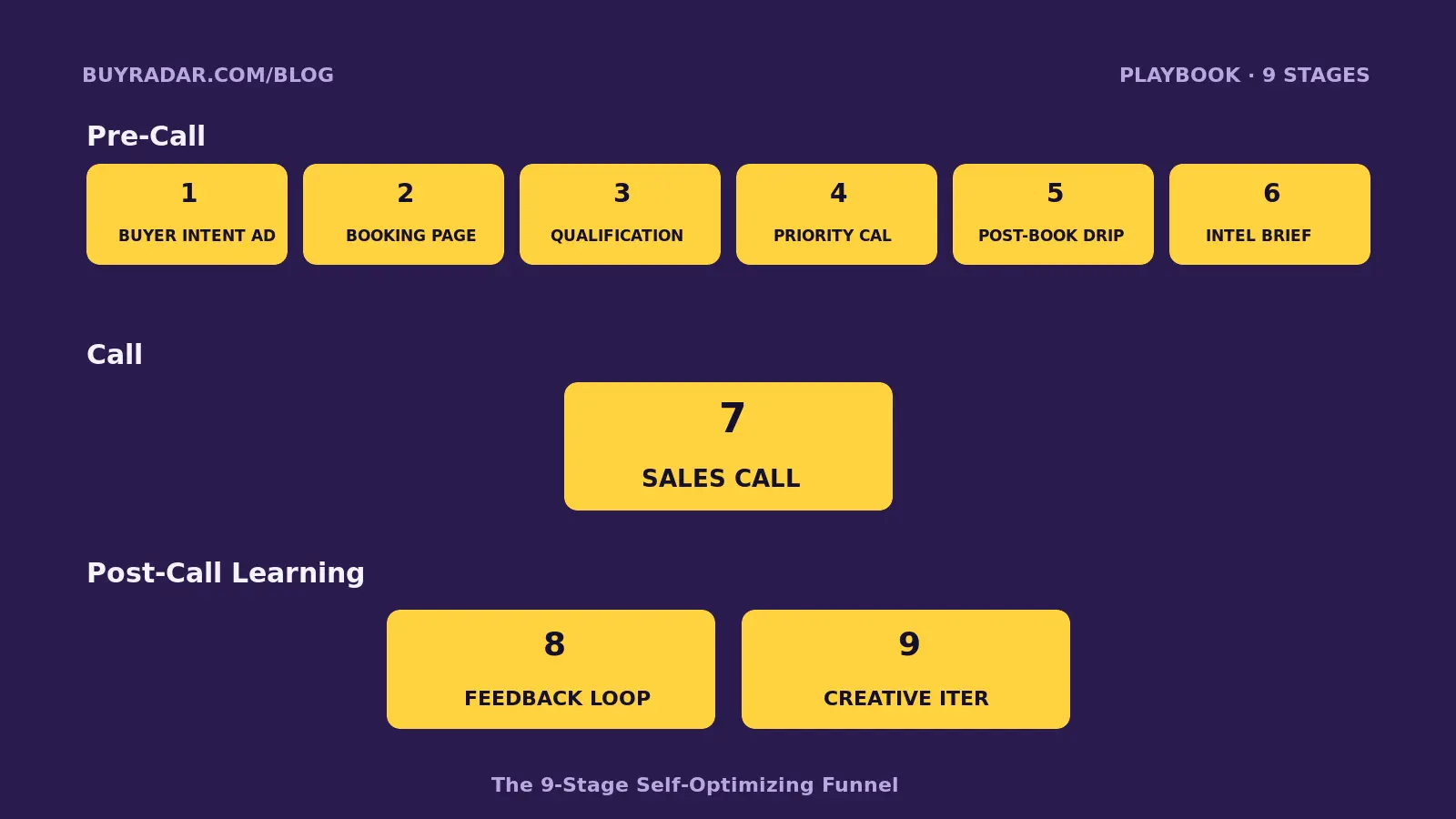
- The 9 stages split into three jobs: pre-call qualification (Stages 1-6), the call itself (Stage 7), and the post-call learning loop (Stages 8-9). Each job feeds the next, which is why the funnel compounds instead of plateauing.
- The biggest single move is the Booking Feedback Loop. Listening to actual sales calls every week and feeding objections back into ads and qualification questions inside 7 days. Most agencies never close that loop.
- Funnel takes 4 weeks to install and works above $2K per month in ad spend. Below that the creative variance math breaks.
The full 9-stage self-optimizing funnel BuyRadar runs for B2B agencies on Meta. From the ad that filters before it gets a click, to the weekly creative loop that learns from every sales call. Step-by-step breakdown with the mechanic behind each stage.
The 9 stages
Stage 1 - Buyer Intent Ad
A cold-paid creative built to filter, not just attract. The ad qualifies the wrong people out before BuyRadar pays for a click. Enough hook variance every week for the algorithm to find agency owners who match the retainer floor. Tire kickers scroll past while the right buyer sees a hook that names their exact problem.
Stage 2 - Dynamic Booking Page
A landing page that adapts based on which ad got the click. Headline, proof, and offer all swap to match the angle that pulled the visitor in. Someone who clicked the stuck-at-7-figures hook lands on a page about scaling past 7. Someone who clicked the ad-fatigue hook lands on a page about fresh creative supply. The closer the page matches the click, the more slots get booked.
Stage 3 - Qualification
Screening questions baked into the booking flow itself. Revenue range, team size, ad-spend readiness, and timeline all answered before a slot is reserved. The form does the work a junior SDR used to do. Anyone who picks the under-$50K-MRR answer or the just-curious timeline never sees the calendar. Agency owners who actually match the ICP move straight to the next step in the same flow.
Stage 4 - Priority Calendar
Qualified leads see open slots inside 48 hours. Lower-intent answers fall into a slower bucket or drop off entirely. The calendar protects the founder’s time and signals scarcity to the right prospect at the same time. Time-to-call is the strongest predictor of close rate for cold paid leads.
Stage 5 - Post-Booking Drip
Reminders, named-client proof, and a final case study delivered 1 hour before the call. SMS, email, and manual outreach for the highest-value cold leads. The job is one number: show-up rate. Industry default for cold paid traffic sits around 40%. With the drip running properly the rate climbs past 80%. Every point above 40 is pure margin recovered on ad spend.
Stage 6 - Pre-Call Intel Brief
Every booked call ships with a 1-page dossier. Company, current ad stack, hiring signals, the exact qualification answer that flagged them as a fit. The caller walks in already knowing the close angle. Discovery time gets spent on the decision instead of on facts the funnel already captured.
Stage 7 - Sales Call
A 40-minute conversation framed as a consultation. First half is an honest audit of their current funnel. Second half is the offer. Both halves are useful even if they don’t buy. Funnel did the prospecting. The call is for the buying decision.
Stage 8 - Booking Feedback Loop
Every sales call gets reviewed weekly. Objections raised, missed-fit signals, language the prospect used to describe the problem, all extracted and fed back into the ad copy and the qualification questions inside 7 days. The funnel learns from real buyer language instead of guesses. By week 4 the ads sound like the prospects, because they were literally written by the prospects.
Stage 9 - Winning Creative Iteration
Every Monday 3 net-new creatives ship into the account. By Friday the A/B data is in. Winners scale into the highest-intent audiences. Anything fatigued dies the same week. Most agencies wait for the algorithm to break before they refresh. BuyRadar’s pace is fast enough that the fatigue plateau never gets a chance to form.
Why it’s a system, not a checklist
The 9 stages are not 9 independent tactics. They are one machine where each stage gets paid by the one before it. That is the difference between a funnel that compounds and a checklist that sits flat.
Look at how the inputs move. The Buyer Intent Ad feeds the Dynamic Booking Page signal on which angle pulled the click. The Booking Page feeds Qualification a warmed-up visitor who has already self-selected on offer fit. Qualification feeds the Priority Calendar a pre-scored lead, so the calendar knows who deserves the 48-hour slot. By Stage 4 the prospect has been filtered three times, without a human ever touching the funnel.
Then the show-up problem. Post-Booking Drip protects every Stage 1 through 4 dollar by getting the prospect to actually attend. The Pre-Call Intel Brief makes that attendance count, because the founder walks in armed instead of guessing. Show-up climbs from a 40% industry default to over 80%, and every booked call burns less founder time on discovery.
The Sales Call is the only stage where revenue gets recognized. Everything before it exists to make Stage 7 short and ready to close. Everything after it exists to make the next Stage 7 better.
That is what the Booking Feedback Loop and Winning Creative Iteration are doing together. The Loop turns this week’s objections into next week’s ad copy and qualification questions. Creative Iteration ships 3 new ads every Monday with that updated language baked in. The funnel rewrites itself every 7 days using the actual words of the people who almost bought. Most agencies launch a funnel, run it, then watch it decay. BuyRadar’s funnel decays slower because it learns faster.
Frequently asked questions
Can I run only some stages?
Technically yes. Practically no. Each stage solves a problem the next stage assumes is already solved. Skip Qualification and the Priority Calendar fills up with bad-fit leads, which destroys the founder's calendar inside two weeks. Skip the Post-Booking Drip and show-up drops back to 40%, which doubles the cost per held call. Skip the Booking Feedback Loop and Winning Creative Iteration runs on guesses, which puts the account on a 60-day fatigue clock. The math works because the stages cover each other's failure modes.
How long until the funnel is fully installed?
4 weeks end to end. Week 1 builds Stages 1 and 2: the first cohort of Buyer Intent Ads and the Dynamic Booking Page variants. Week 2 builds Stages 3 and 4: the qualification form, the routing logic, the priority calendar. Week 3 builds Stages 5 and 6: the post-booking drip and the intel brief template. Week 4 turns on Stages 8 and 9: the first sales call reviews and the first Monday creative drop. Stage 7 happens as soon as the first qualified slot books, usually inside week 2.
What's the minimum ad spend for the funnel to work?
$2K per month is the floor. Below that the math on creative variance breaks. Winning Creative Iteration ships 3 new ads every Monday. To statistically pick a winner by Friday, each ad needs enough impressions to clear the noise. Under $2K per month each ad gets too few impressions and the test is just luck. Above $2K the variance economics work, the weekly refresh produces real signal, and the Booking Feedback Loop has enough actual sales calls per week to extract usable language from.
Does this work outside B2B agencies?
Architecturally yes. The 9-stage shape is portable to any high-ticket B2B offer that runs on cold paid social and closes on a call. Qualification questions, ad angles, and the intel brief template all change. The structure does not. What does not port cleanly is the input library. BuyRadar's hook bank, qualification matrix, and objection corpus are tuned to agency owners. Use the funnel outside B2B agencies and the shape still holds, but the inputs need rebuilding from scratch on the new audience.